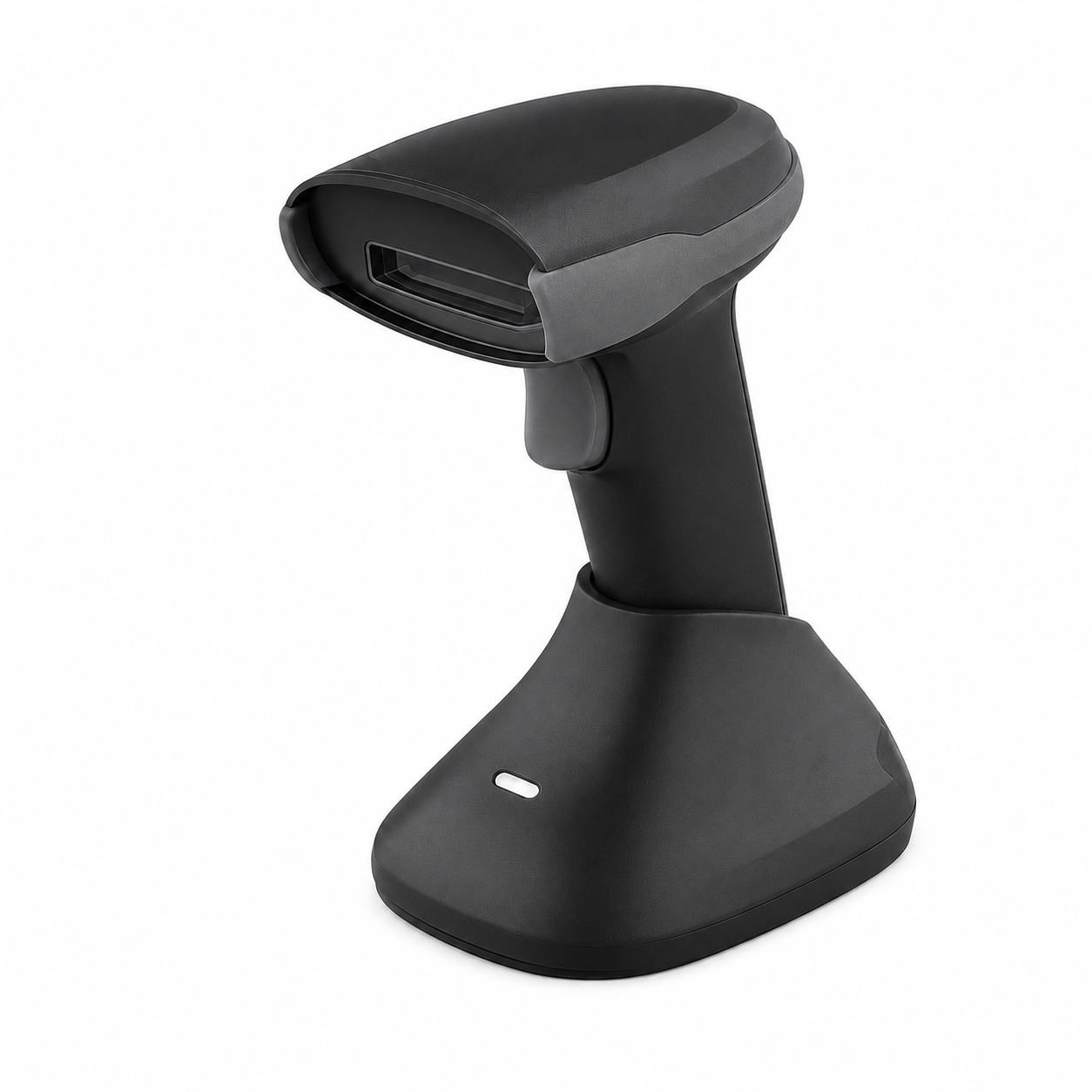
1D vs 2D barcode scanners differ mainly in scanning technology, supported barcode types, reading capability, and the environments in which they are designed to work. For businesses choosing a barcode scanner, understanding these differences can make it much easier to select the right device.
A 1D barcode scanner is mainly designed for traditional linear barcodes, while a 2D barcode scanner can normally read both 1D barcodes and 2D codes such as QR Code and Data Matrix. Industrial barcode scanners go a step further by adding stronger durability, environmental protection, and more reliable scanning in demanding working conditions.
In this guide, we compare 1D, 2D, and industrial barcode scanners based on their scanning technology, barcode support, reading capability, protection level, applications, advantages, and limitations.
1D vs 2D Barcode Scanners: What Are the Main Differences?
The table below provides a quick comparison between 1D barcode scanners, 2D barcode scanners, and industrial barcode scanners.
| Comparison | 1D Barcode Scanner | 2D Barcode Scanner | Industrial Barcode Scanner |
|---|---|---|---|
| Scanning Technology | Laser linear scanning or linear CCD technology. | Commercial-grade CMOS image scanning technology. | High-speed industrial CMOS combined with stronger hardware and decoding components. |
| Barcode Types | Mainly reads linear barcodes printed on paper, metal, plastic, or other surfaces. | Reads both 1D and 2D barcodes on paper and mobile phone screens. | Supports a wider range of barcodes, including small codes, high-density codes, and DPM codes. |
| Reading Capability | Requires better alignment with the barcode and generally cannot read codes displayed on phone screens. It has relatively limited tolerance for damaged barcodes. | Supports omnidirectional recognition and can read screen-based barcodes. It also provides better decoding performance for slightly damaged or imperfect barcodes. | Designed for difficult barcode conditions such as oil stains, scratches, low contrast, and challenging surfaces. Some models can also read miniature high-density barcodes. |
| Protection Level | Usually lower protection, commonly around IP31 to IP42, with lighter housings and limited dust, water, or drop protection. | Typically provides medium protection such as IP42 to IP52 and may support drops from around 1.5 meters depending on the model. | Higher industrial protection, commonly IP65 to IP67, with stronger dust resistance, water resistance, and improved drop durability. |
| Typical Applications | Traditional retail, bookstores, small pharmacies, and other environments mainly using standard product barcodes. | Mobile payment, retail checkout, e-commerce warehouses, government services, and apparel retail. | Automotive manufacturing, electronics, semiconductor applications, heavy industry, factories, and cold-chain logistics. |
| Advantages | Lower cost, mature technology, clear scanning lines, and fast recognition of standard high-contrast barcodes. | Wide application range, supports both 1D and 2D codes, can scan codes from screens, and usually offers good value for general commercial use. | Long service life, better adaptability to demanding environments, stronger decoding performance, and more stable operation under industrial conditions. |
| Limitations | Cannot read 2D codes or most phone-screen barcodes and may have difficulty with damaged barcodes. | Standard commercial models may have limited performance when reading reflective metal DPM codes or heavily contaminated barcodes. | Higher cost and heavier construction. For ordinary retail environments, the additional industrial performance may not always be necessary. |
Quick recommendation: if you are certain that your application only requires standard 1D barcodes and budget is the main concern, a 1D scanner may be enough. Otherwise, a 2D barcode scanner is generally more flexible because it can read both 1D and 2D codes.
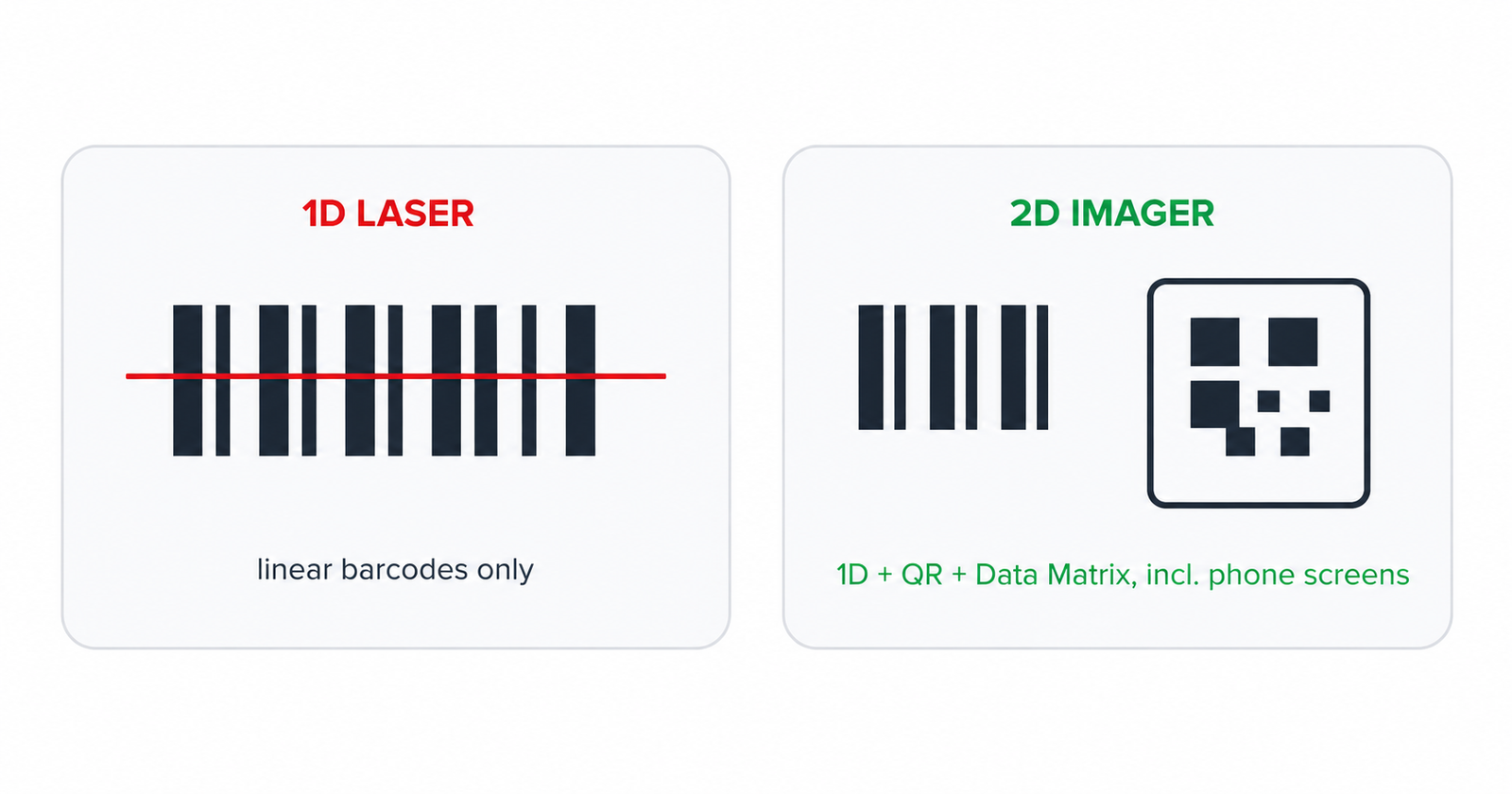
What Is a 1D Barcode Scanner?
A 1D barcode scanner is mainly designed to recognize traditional one-dimensional barcodes. These are the horizontal black-and-white barcode patterns commonly found on product packaging, shipping documents, warehouse labels, and retail products.
Common 1D barcode formats include:
- Code 128
- Code 39
- EAN-13
- UPC-A
- GS1-128
1D scanning technology is mature, usually relatively inexpensive, and fast when reading clear standard barcodes. If your application only requires product barcodes, inventory labels, or logistics tracking numbers, a 1D barcode scanner may be sufficient.
When Does a 1D Scanner Make Sense?
A 1D scanner is most suitable when your barcode system only uses traditional linear barcodes and you do not need to scan QR codes or other 2D symbols.
It can be a practical choice for traditional retail, bookstores, small pharmacies, and other environments where standard product barcodes remain the main barcode format.
What Is a 2D Barcode Scanner?
A 2D barcode scanner normally uses image-based scanning technology, often referred to as an imager. Instead of reading only a single scanning line, the scanner captures an image of the barcode area and then decodes the information.
This allows a 2D scanner to read both traditional one-dimensional barcodes and two-dimensional codes.
Barcodes a 2D Scanner Can Read
Typical 1D barcode formats include:
- Code 128
- EAN
- UPC
Typical 2D barcode formats include:
- QR Code
- Data Matrix
- PDF417
- Aztec
Because 2D barcode scanners can read more barcode types and can also scan codes displayed on mobile phone screens, they are widely used in retail, payment, healthcare, logistics, warehousing, e-commerce, and other commercial applications.
Why Choose a 2D Barcode Scanner?
Compared with a basic 1D scanner, a 2D scanner provides greater flexibility. It can read both 1D and 2D codes and usually offers better performance when barcode orientation is inconsistent or when barcodes are slightly damaged.
For businesses that may need to scan QR codes, phone-screen barcodes, or a combination of different barcode formats, a 2D barcode scanner is usually the more versatile option.
What Is an Industrial Barcode Scanner?
An industrial barcode scanner is generally a more rugged type of barcode scanner designed for demanding working environments. Many industrial scanners use 2D imaging technology but place greater emphasis on durability, stability, decoding capability, and resistance to harsh conditions.
Industrial barcode scanners are commonly used in warehouses, logistics centers, production lines, factories, automotive manufacturing, machinery, electronics, heavy industry, and cold-chain environments.
What Makes an Industrial Scanner Different?
Compared with a standard commercial 2D scanner, an industrial barcode scanner may provide stronger protection and durability, including:
- Higher drop resistance, such as repeated drops from approximately 1.5 m, 1.8 m, or 2 m depending on the model
- Higher IP protection ratings such as IP54, IP65, or IP67
- Better dust and water resistance
- A wider working temperature range
- Improved resistance to vibration
- A stronger and more durable housing
- More stable continuous scanning performance
- Stronger decoding capability for difficult barcodes
- Better performance with dirty, scratched, blurred, or low-contrast barcodes
Some industrial scanners are also designed for more difficult barcode applications, including DPM codes, miniature barcodes, and high-density codes.
Which Barcode Scanner Should You Choose?
When comparing 1D vs 2D barcode scanners, the most important question is not simply which scanner is more advanced. The right choice depends on the barcode types you need to scan and the environment in which the scanner will be used.
Choose a 1D Scanner If:
- You only scan standard linear barcodes
- You do not need QR code scanning
- You do not need to scan phone screens
- Your working environment is relatively clean
- Budget is an important consideration
Choose a 2D Scanner If:
- You need both 1D and 2D barcode scanning
- You need to scan QR codes
- You need to scan barcodes from phone screens
- You work in retail, payment, logistics, or warehousing
- You want greater flexibility for future applications
Choose an Industrial Scanner If:
- You work in a factory or production environment
- The scanner may be dropped frequently
- Dust or water protection is important
- You need to scan difficult or damaged barcodes
- You need stronger durability for continuous use
Final Thoughts on 1D vs 2D Barcode Scanners
For applications that only use traditional linear barcodes, a 1D barcode scanner can still be a simple and cost-effective solution. However, a 2D barcode scanner offers greater flexibility because it can read both 1D barcodes and 2D codes such as QR Code and Data Matrix.
For warehouses, factories, production lines, logistics centers, and other demanding environments, an industrial barcode scanner may be more suitable because it provides stronger protection, durability, and decoding capability.