A barcode scanner is something most of us have seen many times. At a supermarket checkout, the cashier points a scanner at a product, you hear a quick “beep,” and the product name and price immediately appear on the screen.
It is easy to think that the scanner has somehow scanned the price directly from the product.
But that is not really what happens.
What Is a Barcode Scanner?
A barcode scanner is a data collection device used to read barcodes or QR codes and send the information they contain to a computer, POS system, warehouse management system, or other device.
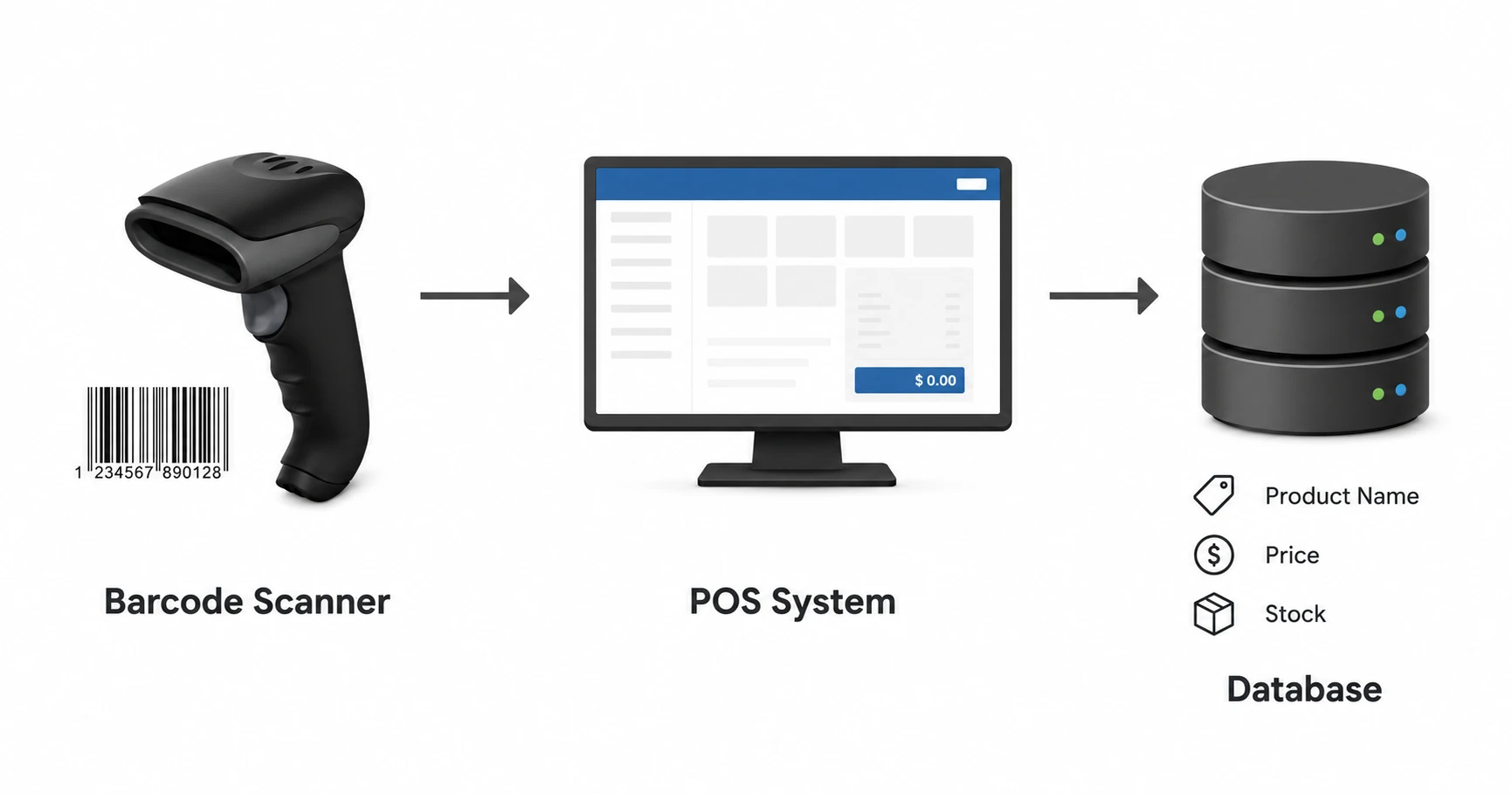
The scanner itself usually does not know how much a product costs.
What it actually does is read the number stored in the barcode and send that number to the connected system. The system then uses that number to find the corresponding product information, such as the product name, price, or stock quantity.
For example, when a product is scanned at a supermarket checkout, the barcode scanner may only send a product number to the POS system. The price displayed on the screen comes from the system behind it, rather than from the scanner itself.
A barcode scanner is more like a data entry point between a physical product and a computer system than simply a machine that “scans things.”
Barcode Scanners Can Have Different Forms
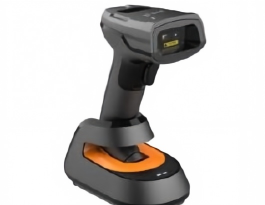
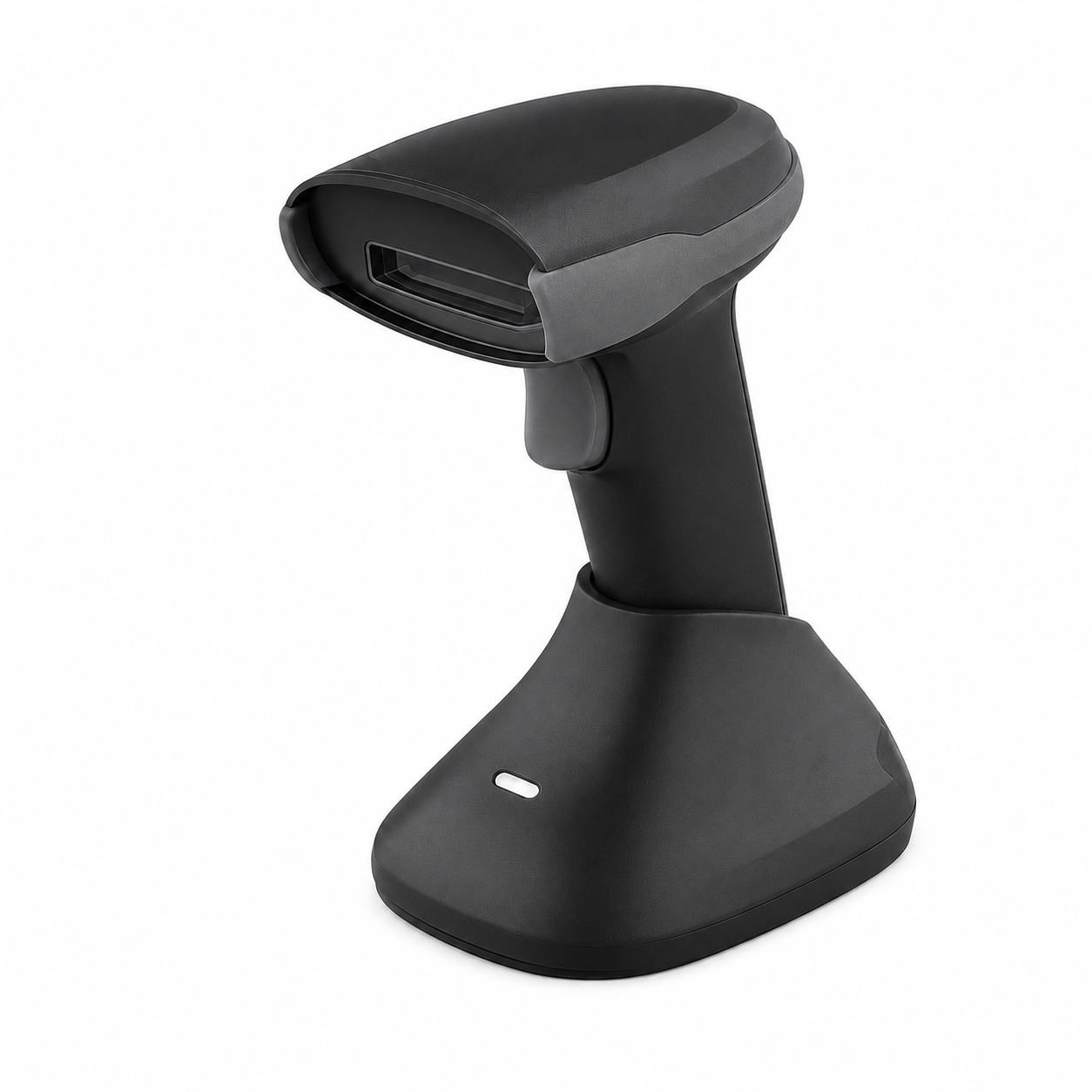
When people hear the term “barcode scanner,” the first thing that often comes to mind is the handheld scanner commonly seen in supermarkets, warehouses, or logistics centers.
However, a handheld scanner is only one common form of barcode scanner.
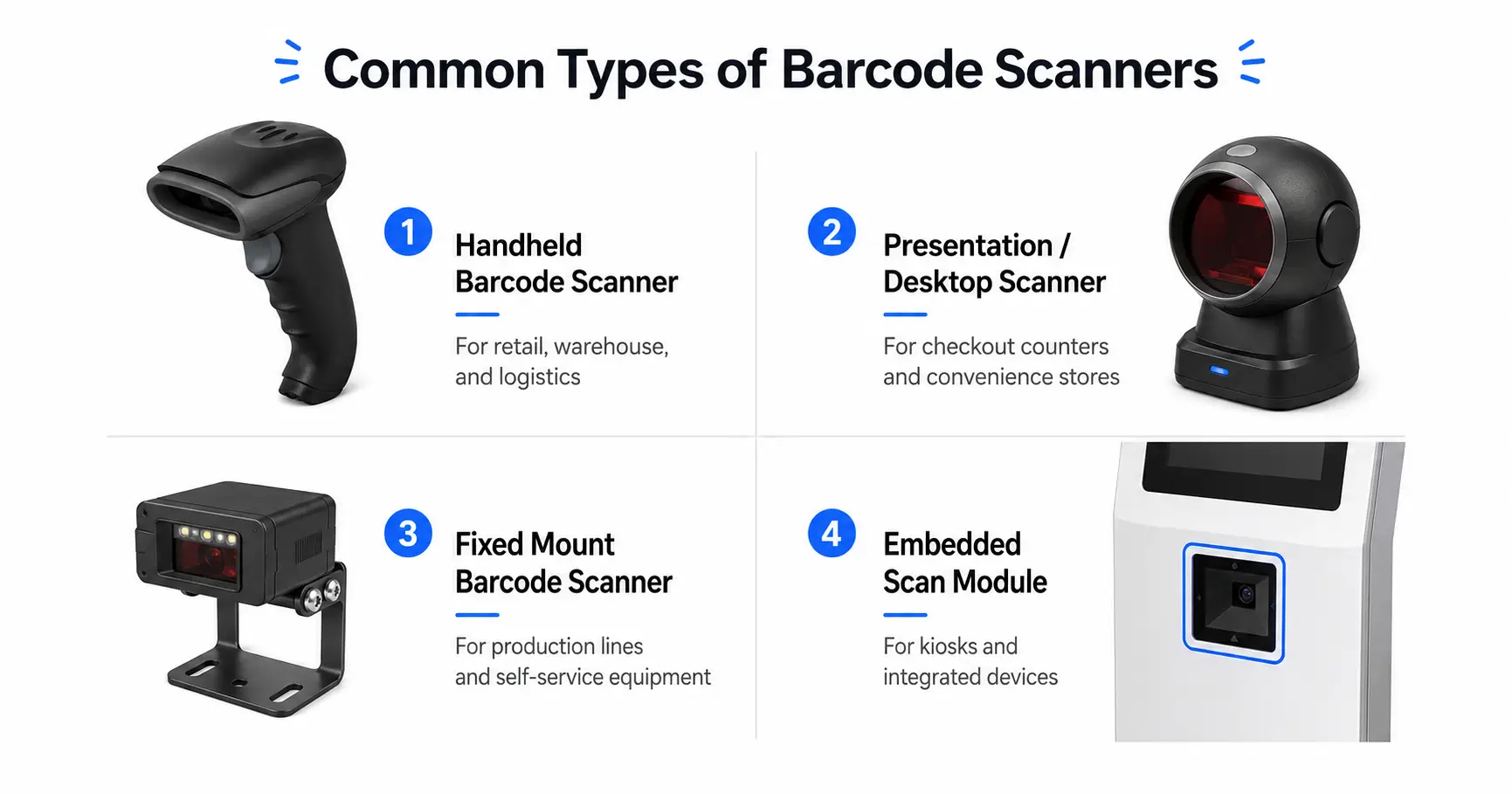
Depending on how the scanner is used, barcode scanning equipment can appear in several different forms:
- Handheld Barcode Scanner: commonly used in retail, warehouses, and logistics.
- Presentation / Desktop Scanner: commonly used at supermarket checkout counters and convenience stores.
- Fixed Mount Barcode Scanner: commonly installed on production lines, sorting equipment, and self-service devices.
- Embedded Scan Module: usually integrated directly into self-service terminals or other machines.
1D and 2D Barcode Scanners
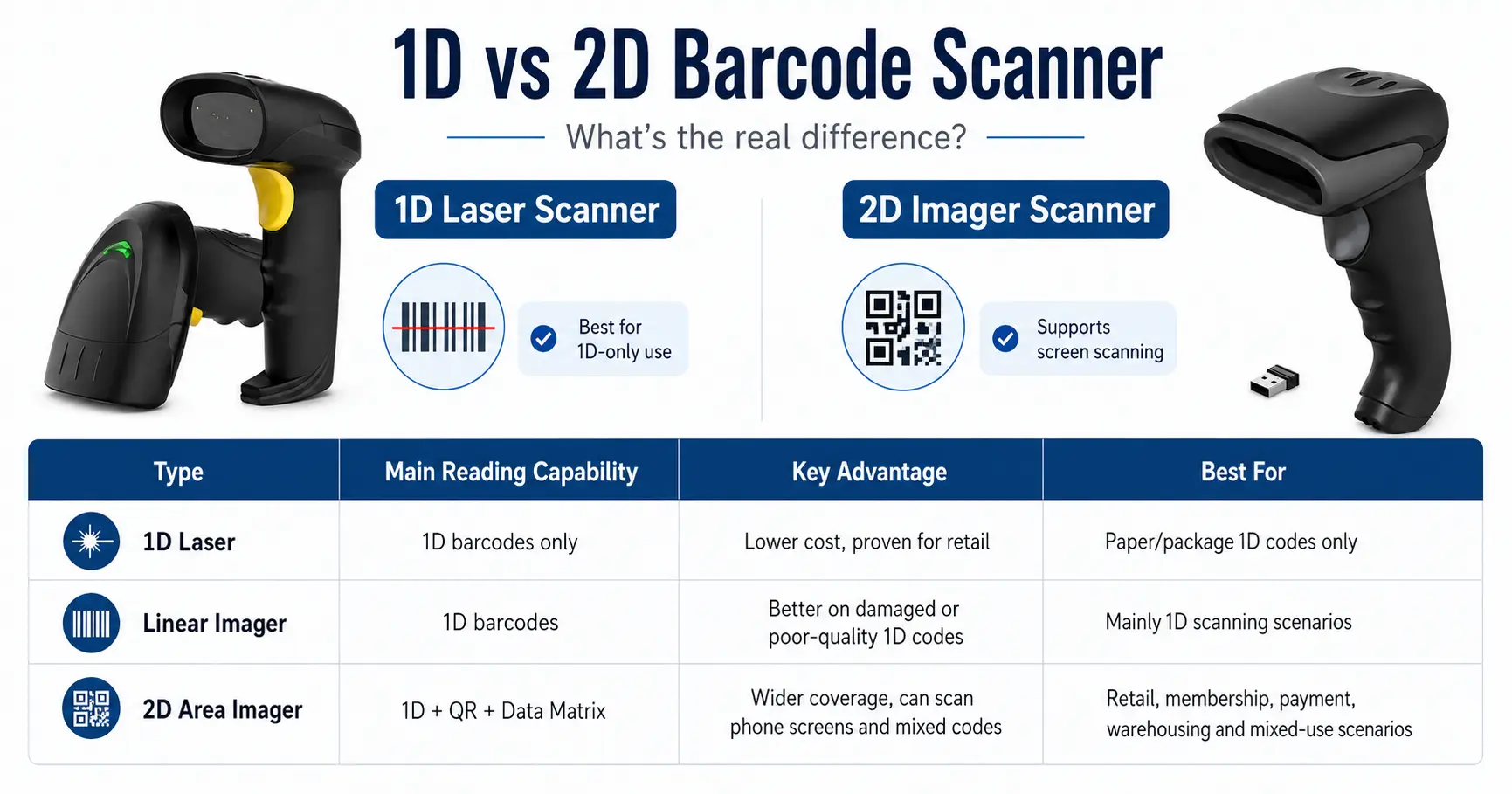
Barcode scanners can also be classified according to the types of barcodes they are able to read.
The two common categories are 1D barcode scanners and 2D barcode scanners.
A 1D barcode scanner is mainly used to read traditional one-dimensional barcodes such as EAN, UPC, and Code 128. These barcodes are commonly used in retail, warehousing, and product management.
A 2D barcode scanner can usually read common 1D barcodes as well as two-dimensional codes such as QR Code, Data Matrix, and PDF417.
Because of this, 2D scanners are also commonly used in logistics, manufacturing, mobile payment, and other applications where two-dimensional codes need to be scanned.
What Is an Industrial Barcode Scanner?
In factories, logistics centers, and other more demanding working environments, you may also come across the term industrial barcode scanner.
Industrial does not mean that the scanner reads a completely different type of barcode.
An industrial barcode scanner can still be a 1D or 2D scanner.
The difference is mainly in the design of the scanner and the environment in which it is expected to work.
Compared with ordinary commercial scanners, industrial barcode scanners usually place more emphasis on drop protection, IP protection, stable operation during continuous use, and the ability to read difficult barcodes such as blurred, damaged, or low-contrast codes.
How Does a Barcode Scanner Work?
Although barcode scanners can look very different and may be used in completely different environments, their basic job is much the same.
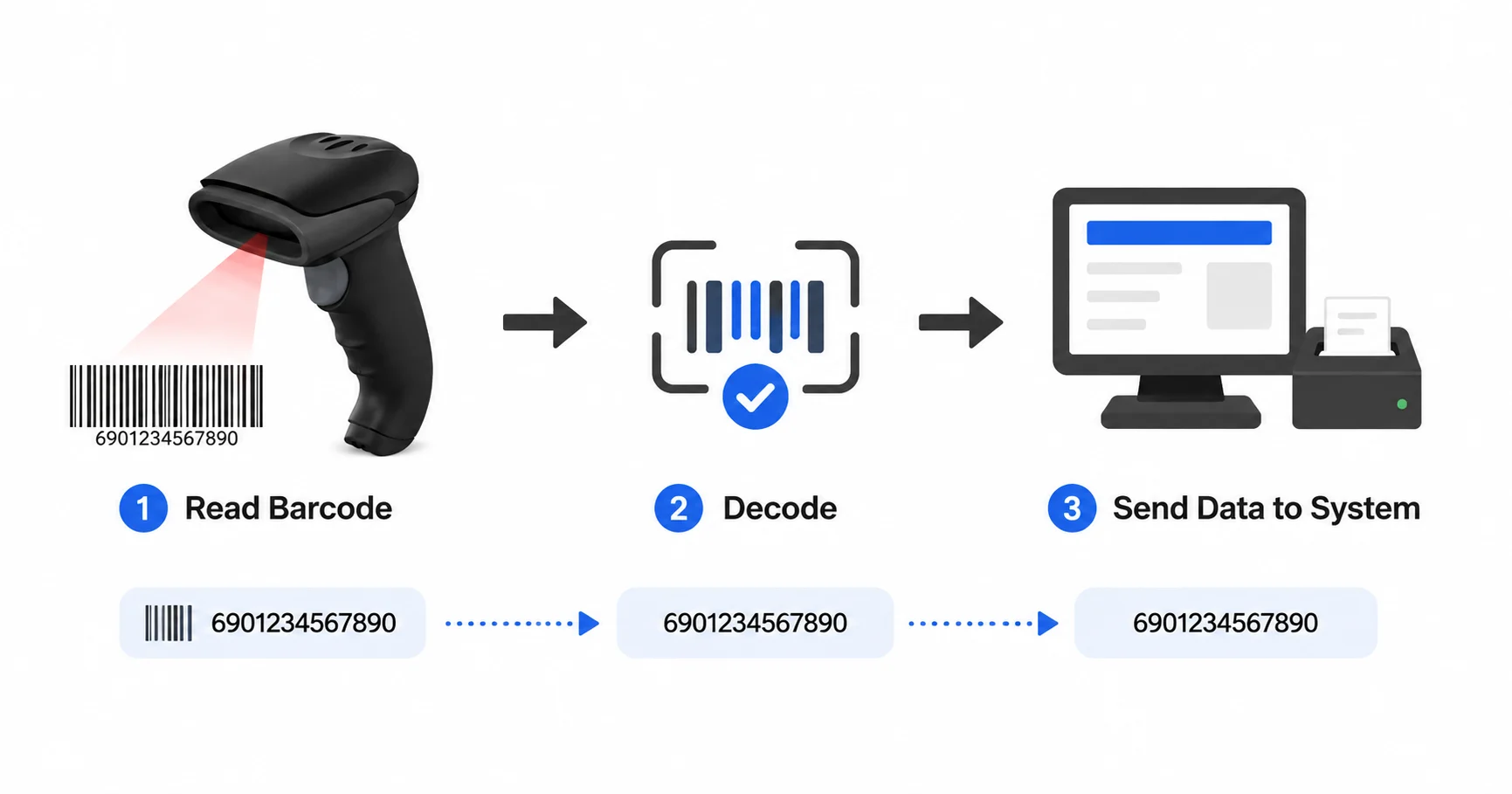
A barcode scanner is mainly doing three things:
For example, suppose a product barcode contains the following number:
After the scanner reads the barcode, it decodes the information and sends:
to the POS system.
The POS system then searches its database for the record that matches this number and may find information such as:
- Product name
- Product price
- Product number
- Stock quantity
- Other product information
What Does a Barcode Scanner Actually Do?
There is one point that is easy to misunderstand.
A barcode scanner normally does not store product prices, stock quantities, or other complete product information.
Its main job is to collect data quickly and accurately and send that data to the connected system.
The computer, POS system, warehouse management system, or other software then uses that data to find the information it needs.
This is also why barcode scanners are used far beyond supermarket checkout counters. They can be found in warehouses, logistics centers, factories, hospitals, self-service terminals, and automated production lines.
The scanners may look different, but their basic purpose remains the same: read the barcode, decode the data, and send it to the system that needs it.